
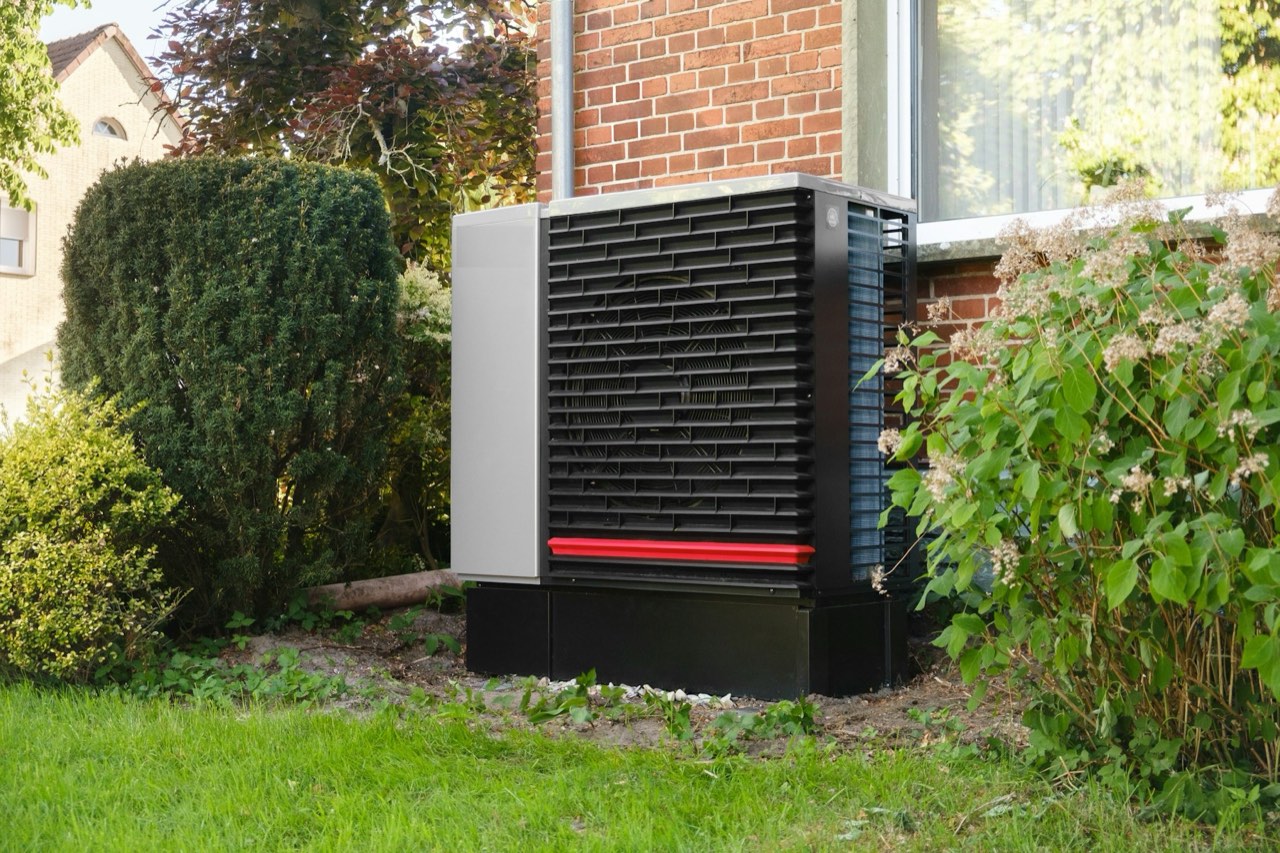
Most air source heat pumps on houses in England do not need planning permission. They count as permitted development, as long as the unit passes a noise calculation and meets a short list of size and siting limits. Listed buildings are the main exception, and conservation areas add extra rules about where the unit can go.
These rules changed on 29 May 2025, so older advice you find online may be out of date. Everything below is for England, which covers all of Shropshire and Telford and Wrekin.
The permitted development rules
The rules are in Class G, Part 14, Schedule 2 of the General Permitted Development Order 2015. We checked the current text on legislation.gov.uk, which is up to date to 15 October 2026.
An air source heat pump on a house, or within its garden, is permitted development unless any of these apply:
| Limit | Rule |
|---|---|
| Noise | It must meet the MCS planning standard, now MCS 020(a) |
| Number of units | One on a house that is not detached or on a block of flats; two on a detached house |
| Size | The outdoor unit, including any housing, must be no more than 1.5 cubic metres on a house (0.6 cubic metres on a block of flats) |
| Roofs | Not on a pitched roof. On a flat roof, it must be at least 1 metre from the edge |
| Wind turbines | Not if there is already a wind turbine on the building or in the garden |
| Heritage | Not on a scheduled monument, or on a listed building or within its curtilage |
| Conservation areas and World Heritage Sites | Not on a wall or roof that fronts a highway, and not nearer to a highway than the nearest part of the house |
| Elsewhere | Not on a wall that fronts a highway above ground floor level |
| Use | It must not be used only for cooling |
There are also conditions. The unit must be sited, so far as practicable, to minimise its effect on the look of the building and on the amenity of the area. It must be removed as soon as reasonably practicable once it is no longer needed.
What changed in 2025
The Town and Country Planning (General Permitted Development) (England) (Amendment) Order 2025 came into force on 29 May 2025. It:
- removed the rule that the unit had to be at least 1 metre from the property boundary;
- raised the size limit from 0.6 to 1.5 cubic metres for houses;
- allowed two heat pumps on a detached house instead of one;
- added the condition that the heat pump is not used solely for cooling; and
- made MCS 020(a) the noise standard, removing the option of “equivalent standards”. A transitional period for the old wording ended at the end of 28 May 2026.
MCS says compliance with MCS 020(a) applies to any installation relying on permitted development, whether or not the installer is MCS certified.
The noise standard: MCS 020(a)
MCS 020(a) sets a permitted development noise limit of 37 dB (LAeq over 5 minutes) at each assessment position. An assessment position is a point 1 metre outside the centre of any door or window to a habitable room of a neighbouring home, such as a living room or bedroom. Bathrooms, hallways and utility rooms do not count.
The installer works this out with a set calculation:
- Identify every neighbouring window or door that could be affected. There may be several.
- Take the heat pump’s A weighted sound power level from the manufacturer’s data. The standard says the level in “low noise mode” must not be used.
- Allow for the distance, the number of reflecting surfaces within 1 metre of the unit (the ground and any walls), and any barrier such as a solid wall or fence between the unit and the window.
- Check the result against 37 dB.
The installer must give you a copy of the completed calculation. Passing it does not by itself make the job permitted development: every other limit in the table above still has to be met.
If the unit fails, you can still apply for planning permission. The inputs to the calculation show the options: more distance from the neighbour’s window, a barrier in the line of sight, fewer reflecting walls, or a model with a lower sound power level.
Where the unit can go
With the 1 metre rule gone, the noise calculation is what decides how close to a neighbour the unit can sit. In practice that means:
- a back or side wall, or a spot in the garden, away from neighbours’ bedroom and living room windows;
- not tucked into a tight corner: each wall within 1 metre adds to the noise level, and a unit with more than three reflecting surfaces around it, such as in a small lightwell, cannot meet MCS 020(a);
- ground level or a flat roof, never a pitched roof;
- not on the front wall facing the road in a conservation area; and
- with safe access for servicing, which the MCS design standard requires.
The MCS design standard also requires installers to make you aware of all permissions needed for the job, and to follow MCS 020(a) whenever they rely on permitted development.
Listed buildings
Permitted development does not apply to an air source heat pump on a listed building or on land within its curtilage. You will need to apply for planning permission.
You are also likely to need listed building consent. Section 7 of the Planning (Listed Buildings and Conservation Areas) Act 1990 says no one may carry out works to alter a listed building in a way that affects its character as a building of special architectural or historic interest unless those works are authorised. That can include internal pipework and radiators, so ask the council. Our guide to heat pumps in old houses covers the design side.
Shropshire has a lot of listed buildings. The national heritage list holds about 784 list entries in Shrewsbury parish, about 425 in Ludlow and about 138 in Oswestry, and one entry can cover a whole terrace.
Conservation areas and Article 4 Directions
A heat pump in a conservation area can still be permitted development, but it must not go on a wall or roof that fronts a highway, or sit nearer to a highway than the house. Shropshire Council says it has 128 conservation areas, and Telford and Wrekin has 8.
An Article 4 Direction or a planning condition can remove permitted development rights altogether. Shropshire Council’s mapping shows Article 4 Directions in parts of Shrewsbury, including Belle Vue, Castlefields, Mountfields and The Mount, and in Bridgnorth. We could not confirm whether each one covers heat pumps, so if you live in one of these areas, use the council’s checker map and ask the council before you order.
If you live in Shrewsbury or Bridgnorth town centre, it is worth checking before you get quotes.
Paperwork after installation
Planning is not the only paperwork. An MCS certified installer must also register the installation and send you an MCS certificate within 10 working days of commissioning. Using an MCS certified installer is a condition of the Boiler Upgrade Scheme grant.
If you are near the Welsh border
These rules are for England. Wales has its own permitted development rights for air source heat pumps. MCS says that from 1 June 2026 they allow two units on a detached house within a 40 dB limit, and different boundary and siting rules. If your property is over the border, check the Welsh rules with your installer.
Quick checklist
- Is the house or anything in its grounds listed? If yes, you need planning permission.
- Is it in a conservation area or covered by an Article 4 Direction? Check the council map.
- Is the outdoor unit 1.5 cubic metres or less?
- Has the installer done the MCS 020(a) calculation and given you a copy?
- Is the unit at ground level or on a flat roof, at least 1 metre from the edge?
Planning a heat pump? Get a quote from a checked local installer.
Common questions
Do I need planning permission for an air source heat pump?
Usually not, on a house in England. It is permitted development if it passes the MCS 020(a) noise calculation, the outdoor unit is no larger than 1.5 cubic metres, it is not on a pitched roof, and the other limits are met. A listed building, an Article 4 Direction or a planning condition can take those rights away.
How close to my boundary can a heat pump go?
There is no longer a fixed distance. The 1 metre boundary rule was removed on 29 May 2025. Instead the unit must meet the 37 dB noise limit at your neighbours' nearest habitable room windows and doors, which in practice controls how close it can be.
How loud is 37 dB?
It is a low limit. The MCS calculation uses the heat pump's full sound power, not its low noise mode, and works out the level at 1 metre outside a neighbour's living room or bedroom window. Barriers such as walls and fences are taken into account.
Can I have a heat pump in a conservation area?
Yes, often under permitted development, but it cannot go on a wall or roof that faces a road, or be nearer to a road than the house itself. Check whether an Article 4 Direction applies to your street.
Related guides
Sources
- legislation.gov.uk, GPDO 2015 Schedule 2 Part 14 Class G, air source heat pumps on domestic premises, up to date to 15 October 2026
- legislation.gov.uk, The Town and Country Planning (General Permitted Development) (England) (Amendment) Order 2025, S.I. 2025/560
- Planning Portal, Planning permission: air source heat pump
- MCS, MCS 020 a) Air Source Heat Pump Sound Calculation, issue 1.1, 14 April 2025
- MCS, New permitted development rules in England: air source heat pump installations must now comply with MCS 020 a), 29 May 2025
- MCS, Changes to permitted development rights in Wales from 1 June 2026
- MCS, MIS 3005-D The Heat Pump Design Standard, issue 3.0, 5 December 2025
- legislation.gov.uk, Planning (Listed Buildings and Conservation Areas) Act 1990, section 7
- Shropshire Council, Conservation areas, checked 17 October 2026
- Shropshire Council, conservation area and Article 4 checker map
- Telford & Wrekin Council, Conservation areas
- Historic England, National Heritage List for England, listed building points (counted within ONS parish boundaries, December 2023)