
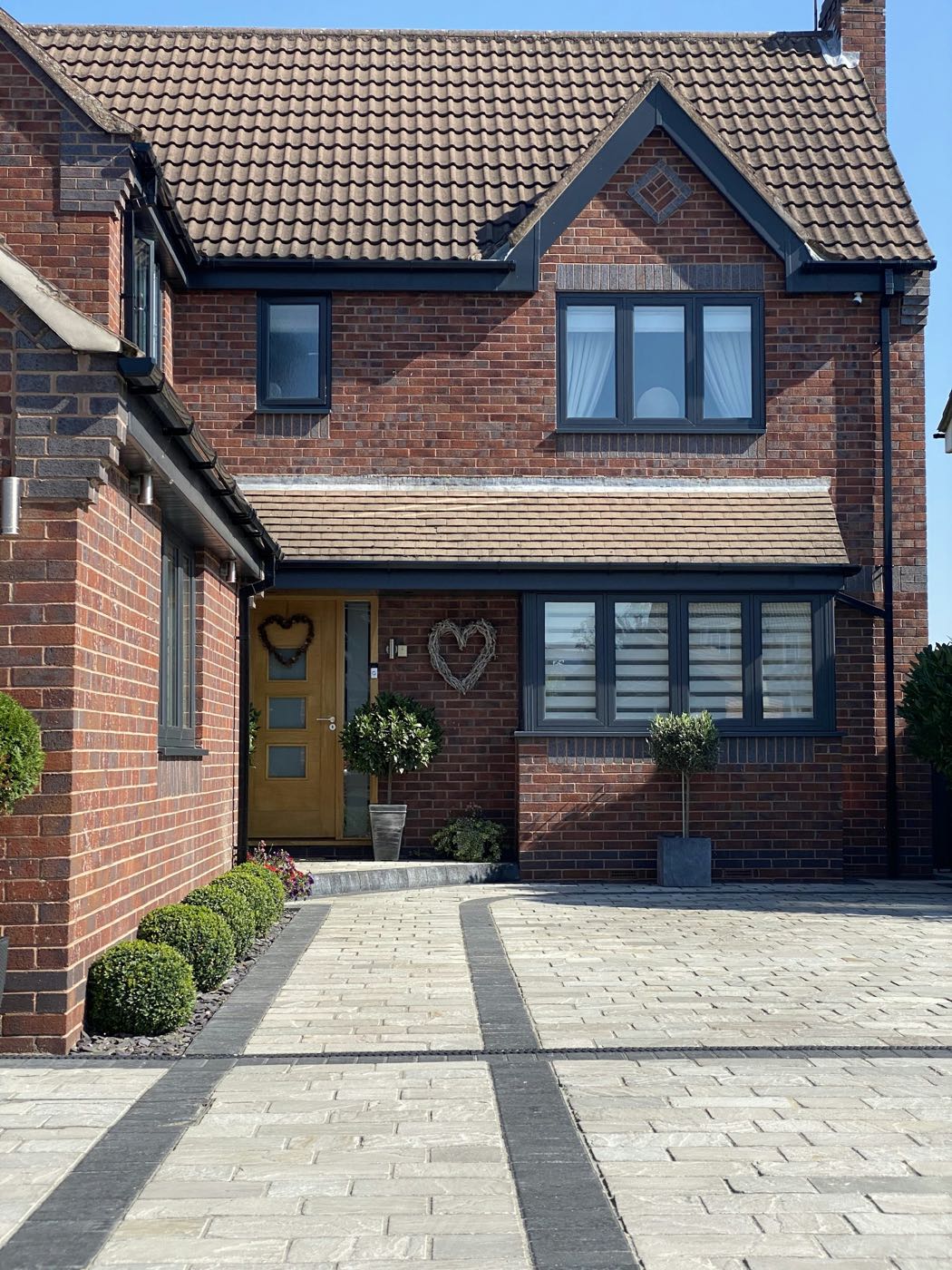
Most new driveways in Shropshire need no planning permission, as long as you live in a house and the surface is permeable, or the rainwater runs to a lawn or border on your land. What almost always needs permission is the dropped kerb, which is a separate application to the council as highway authority.
This guide covers England’s rules, which apply across Shropshire and Telford and Wrekin.
The 5 square metre front garden rule
Since 1 October 2008, paving a front garden has been permitted development only if it does not add to runoff. The rule is in Class F of the General Permitted Development Order. It applies where the hard surface sits between the front wall of the house (the “principal elevation”) and a highway, and covers more than 5 m².
In that case, “either the hard surface is made of porous materials, or provision is made to direct run-off water from the hard surface to a permeable or porous area or surface within the curtilage of the dwellinghouse”. If neither is true, you need planning permission.
In plain terms, from the Planning Portal:
- No permission needed: a new or replacement driveway of any size with permeable surfacing, such as gravel, permeable block paving or porous asphalt. Resin bound counts only if the base below it is permeable too.
- No permission needed: an impermeable drive where the water is directed to a lawn or border to drain naturally.
- Permission needed: a traditional impermeable drive over 5 m² of front garden that does not drain to a permeable area.
Back and side drives that are not between the front wall and a road are not caught by the 5 m² condition. For the differences between surfaces, see resin vs block paving vs tarmac.
When planning permission is needed anyway
The Planning Portal says these rights apply to houses only. They do not cover:
- flats and maisonettes;
- converted houses, or houses created under certain change of use or new-build permitted development rights;
- land with a planning condition, Article 4 Direction or other restriction removing the rights.
If you need an application, the Planning Portal fee schedule from 1 April 2026 lists £272 for operations within the curtilage of a house; the council will confirm the fee.
Article 4 areas in Shropshire and Telford
An Article 4 Direction removes some permitted development rights in a defined area.
Ironbridge Gorge World Heritage Site (Telford & Wrekin). The Article 4 Direction covers houses in the World Heritage Site. Where a house fronts a highway, waterway or open space, it removes permitted development rights for works including gates, fences and walls, and hard surfaces. A new front drive there is likely to need planning permission whatever the material.
Shropshire Council area. The council’s Article 4 map layer lists directions in parts of Shrewsbury (including Belle Vue, Castlefields, Mountfields, The Mount and the Town Centre), Bridgnorth, Llanymynech, Prees and Highley. The council’s guidance says these control features such as windows, doors and boundary walls. We could not confirm whether each direction also covers hard surfaces, so check the council’s conservation area and Article 4 map and ask before you start.
Dropped kerbs: the rules
The Planning Portal says driving over a pavement without a dropped kerb is illegal, and you must apply to your local authority. Approval is under Section 184 of the Highways Act 1980. Planning permission is a separate question.
National rules allow a new access to a road as permitted development when it serves other permitted works, but not onto a trunk road or a classified road. Shropshire Council puts it this way: you need planning permission if the dropped kerb is on a classified road (A, B or C), or serves flats or commercial premises.
Shropshire Council
Applications go to the Street Works Team through the online form on the council’s vehicle access page. Key points from its guidance:
- Fee: charged on application and “not refundable, even in the event of a refusal”. The amount is not shown on the web page or guidance notes, so check it on the form.
- Planning first: if needed, get planning permission before applying.
- Space: 5.6 m from the highway boundary to the house is desirable; 4.8 m is the absolute minimum. A parking width of 3.0 m is recommended, and parking parallel to the road is not generally allowed.
- Size: the standard crossing is 2.75 m wide at the kerb, which means about 4.5 m of kerb is replaced.
- Drainage: the parking area must not drain across the footway or onto the road.
- Who builds it: only an accredited contractor with the right insurance. You cannot do it yourself.
- Timing: apply at least four weeks before the proposed start date, or 12 weeks if a road closure is needed. Approval lasts 3 years, and your contractor books road space with the council before starting.
- Afterwards: you are responsible for defects for 2 years, then the council maintains it as public highway.
Common reasons for refusal include a property on a bend or junction, near traffic signals or crossings, poor visibility or a steep slope. Contact: streetworks@shropshire.gov.uk or 0345 678 9006.
Telford & Wrekin Council
Residents apply through the council’s online dropped kerb form, after checking whether planning permission is needed. Telford & Wrekin will not inspect until planning has been sought.
- Fee: £273, paid on application. If refused, you get it back minus £50 for the inspection.
- Who can apply: the owner. Tenants need a letter of consent from the landlord.
- Space: at least 6 m between the property and the back of the footway, with a hard surface for parking. You can apply with less, but success is less likely.
- Visibility: measured from 2.4 m back from the road edge, 25 m in a 20mph limit and 43 m in a 30mph limit.
- Decision: usually within 30 days. Approval is valid for 12 months, and the work must be finished in that time.
- Who builds it: a contractor from the council’s list, or your own with public liability insurance and street works accreditation. Moving street lights, bollards or utility covers is at your cost.
Contact: Development Management on 01952 380380 or hdc-s184@telford.gov.uk. For likely build costs, see our driveway cost guide.
Flood risk near the Severn and Teme
Permeable drives matter more in parts of Shropshire that already flood.
- Shrewsbury: the River Severn at Welsh Bridge peaked at 5.25 m on 1 November 2000. The Environment Agency says property flooding is possible from 2.90 m, and lists flooding at Coleham Head and Berwick Road at higher levels.
- Bridgnorth: the Severn’s record there is 5.26 m (2 November 2000), with flooding listed on Doctors Lane and Severnside South from 3.70 m.
- Ironbridge: the Buildwas gauge record is 7.04 m (2 November 2000), and the Environment Agency lists flooding to property in Ironbridge as a past impact.
- Ludlow: the River Teme record is 5.22 m (21 July 2007); property flooding is possible from 4.00 m.
A drive cannot stop river flooding, but it should not add surface water. The GOV.UK guidance says to slope the drive away from the house, keep soakaways away from foundations (at least 3 m for a small drive, more on some ground), and that drives steeper than 1 in 20 may not suit permeable surfacing. On heavy clay, a pipe from the sub-base to the roof-water drain may be needed.
Check your address on the GOV.UK long term flood risk service, which covers rivers, surface water and, where data exists, groundwater. Our guide to resin bound vs resin bonded explains which resin finish drains.
Planning a new drive? Get a quote from a checked local installer.
Common questions
Do I need planning permission for a new driveway?
Not usually, if you live in a house and the driveway is permeable or drains to a lawn or border on your land. You do need it if the area is more than 5 square metres of front garden, the surface is impermeable and the water runs off to the road or drains.
Can I drive over the pavement without a dropped kerb?
No. The Planning Portal says driving over a pavement without a dropped kerb is illegal. You must apply to the highway authority, which is Shropshire Council or Telford & Wrekin Council depending on where you live.
Do I need planning permission for a dropped kerb in Shropshire?
Shropshire Council says yes if the road is classified (an A, B or C road), or if the property is flats or commercial. Get any planning permission first, then apply to the Street Works Team.
How much space do I need for a dropped kerb?
Shropshire Council says 5.6 metres from the highway boundary to the house is desirable and 4.8 metres is the absolute minimum. Telford & Wrekin asks for at least 6 metres between the property and the back of the footway.
Can I build the dropped kerb myself?
No. Both councils require an accredited contractor with public liability insurance and street works qualifications to do any work on the public highway.
Related guides
Sources
- GOV.UK (DCLG), Guidance on the permeable surfacing of front gardens, May 2009
- Planning Portal, Paving your front garden: planning permission, checked 17 October 2026
- legislation.gov.uk, GPDO 2015 Schedule 2 Part 1 Class F (hard surfaces), checked 17 October 2026
- legislation.gov.uk, GPDO 2015 Schedule 2 Part 2 Class B (means of access to a highway), checked 17 October 2026
- Derbyshire Specialist Aggregates (ResinBondedAggregates.com), Resin bound vs resin bonded, checked 17 October 2026
- Planning Portal, Application fees England, from 1 April 2026 (V2026.1)
- Shropshire Council, Vehicle access: dropped kerb, checked 17 October 2026
- Shropshire Council, Vehicle access crossings (dropped kerbs): information for applicants, checked 17 October 2026
- Shropshire Council, Dropped kerb guidance notes (general conditions), checked 17 October 2026
- Telford & Wrekin Council, Dropped kerbs, residential guidance updated 15 April 2026
- Telford & Wrekin Council, Article 4 Direction (Ironbridge Gorge World Heritage Site), checked 17 October 2026
- Shropshire Council GIS, Article 4 Direction layer, queried 17 October 2026
- Shropshire Council, Conservation areas and Article 4 guidance, checked 17 October 2026
- GOV.UK, Check for flooding: River Severn at Welsh Bridge, Shrewsbury, checked 17 October 2026
- GOV.UK, Check for flooding: River Severn at Bridgnorth, checked 17 October 2026
- GOV.UK, Check for flooding: River Teme at Ludlow, checked 17 October 2026
- GOV.UK, Check for flooding: River Severn at Buildwas, checked 17 October 2026
- GOV.UK, Check the long term flood risk for an area in England