
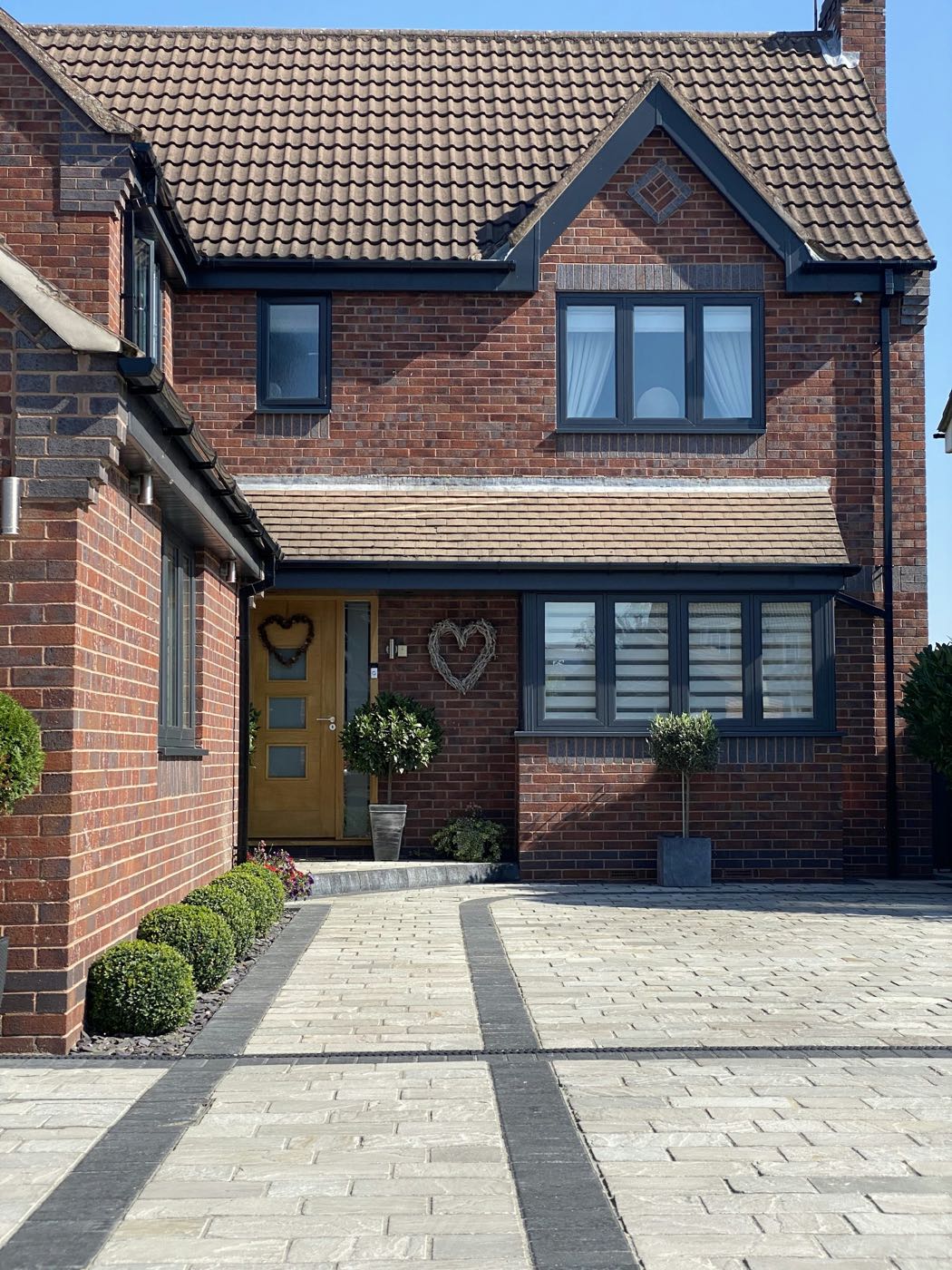
For most Shropshire homes the choice comes down to budget and drainage. Tarmac is usually the cheapest hard surface. Resin bound gives the smartest finish for the money and drains through. Block paving costs the most but is the easiest to repair and, in its permeable form, deals well with rain.
The prices below are national estimates from 2026 guides, not quotes. We have not seen a published Shropshire-only figure, so treat them as a starting point and get itemised quotes.
The short comparison
| Tarmac | Resin bound | Block paving | |
|---|---|---|---|
| Typical installed cost | About £40 to £60 per m² (full dig out) | About £40 to £70 per m² over a sound base, plus £25 to £45 per m² for a new base | About £70 to £120 per m² |
| Typical lifespan | About 15 to 25 years | About 15 to 25 years | About 20 to 30 years or more |
| Drains through? | No, unless porous asphalt | Yes, if laid on a permeable base | Only permeable block paving |
| Upkeep | Low | Low | Medium (weeds, joint sand) |
| Repairs | Patches show | Patches show | Lift and relay single blocks |
Sources: Less.co.uk tarmac, resin and block paving cost guides (April 2026); Homebuilding & Renovating (August 2026).
Cost per square metre
Tarmac is the budget option. One April 2026 guide puts a full dig out and relay at about £40 to £60 per m², and an overlay on a sound existing surface at about £20 to £40 per m². The Federation of Master Builders (FMB) lists tarmac from about £25 per m² for materials, which shows how much labour and groundworks add.
Resin bound sits in the middle. A cost specialist quoted by Homebuilding & Renovating in August 2026 put it at £40 to £70 per m² supplied and fitted, and said “the single biggest swing is what is underneath”. Laying over a sound base keeps the price near the bottom of that range, while a new permeable sub-base adds roughly £25 to £45 per m².
Block paving is the most expensive of the three. Typical installed prices run from about £70 to £120 per m², including excavation, sub-base and laying, with permeable blocks at about £80 to £110 per m². Clay pavers and natural stone setts cost more than standard concrete blocks.
For worked examples on a one-car and two-car drive, see our driveway cost guide.
Lifespan
All three last well if the base is right. Published guides put tarmac at about 15 to 25 years, resin bound at about 15 to 25 years, and block paving at about 20 to 30 years or more. The FMB says resin bound driveways can last over 25 years.
The GOV.UK guidance on paving front gardens describes permeable block paving and porous asphalt as “hard and durable with a very long service life if correctly constructed”. The phrase that matters is “correctly constructed”. A thin or badly compacted sub-base shortens the life of any surface.
Our guide to how long resin driveways last covers what wears each surface out.
Looks
Tarmac is plain and practical. Black is standard and red costs more (one guide says 15 to 25% more).
Resin bound is smooth and seamless, with a wide range of stone colours. Lighter blends show oil marks and moss more readily than darker ones, according to the Homebuilding & Renovating experts. Insist on a UV-stable resin, because cheaper resins can yellow in sunlight.
Block paving gives the most pattern and texture: herringbone, borders, tumbled blocks or clay pavers. A quantity surveyor writing for Homebuilding & Renovating warns that concrete block colour washes out over time, while his own clay driveway kept its colour for 19 years.
Permeability and planning
This is where the choice can decide itself. In England, paving more than 5 m² of the front garden (the area between the front wall of the house and the road) is permitted development only if the surface is porous, or if the rainwater runs to a permeable area within your property. Otherwise you need planning permission.
- Tarmac: ordinary tarmac is impermeable. Over 5 m² at the front, it needs a drainage channel to a lawn, border or soakaway, or planning permission. Porous asphalt is the permeable alternative, and GOV.UK says it “should be provided and laid by a specialist company”.
- Resin bound: permeable, so normally fine without permission. The catch is the base: laying resin over old, sealed tarmac or concrete does not make the drive permeable. Our guide to resin bound vs resin bonded explains this.
- Block paving: standard blocks on a sand bed are treated as impermeable. Permeable block paving, which lets water through the joint material into an open-graded sub-base, counts as permeable.
The rules have exceptions for flats, some converted houses and Article 4 areas, and a dropped kerb is a separate application. See driveway planning and dropped kerbs.
Maintenance
Tarmac needs very little beyond sweeping. Budget for kerb edging, which Homebuilding & Renovating advises to stop the tarmac moving.
Resin bound has no joints for weeds to grow through. Sweep it, clear leaves before they rot and stain, and jet wash occasionally on a wide fan at moderate pressure.
Block paving needs the most attention. Weeds and moss grow in the joints, and the joint sand needs topping up after jet washing. Interpave, the trade body for concrete paving makers, advises gentle annual brushing of permeable block paving and spot treatment of weeds only where needed.
Which to choose
- Tight budget, long drive: tarmac, with edging and proper drainage at the front.
- Smart finish, sound existing base, front garden: resin bound, on a permeable base, with UV-stable resin.
- Heavy use, easy repairs, lots of rain: permeable block paving.
- Near the Severn or Teme, or on heavy clay: a permeable surface with a properly sized sub-base, and ask the installer how the water will get away.
Whatever you pick, the base and the installer matter more than the surface. Ask every quote to list excavation, sub-base depth, drainage, edging and the surface separately, as the FMB recommends.
Planning a new drive? Get a quote from a checked local installer.
Common questions
Which is cheapest: resin, block paving or tarmac?
Tarmac is usually cheapest. April 2026 price guides put it at about £40 to £60 per square metre for a full dig out and relay, against £70 to £120 for block paving. Resin bound can match tarmac if it goes over a sound existing base, but costs more once a new base is needed.
Which driveway lasts longest?
Block paving is usually quoted as the longest lasting, at about 20 to 30 years or more. Tarmac and resin bound are both typically put at about 15 to 25 years. The base and the quality of installation matter more than the surface.
Do I need planning permission for a tarmac driveway?
In England, if it covers more than 5 square metres of front garden and is ordinary impermeable tarmac, you need planning permission unless the rainwater runs to a lawn, border or soakaway on your land. Porous asphalt avoids the problem.
Is resin better than block paving?
It depends what you want. Resin bound gives a smooth, seamless finish with no joints for weeds, but patch repairs usually show. Block paving costs more and needs occasional weeding and re-sanding, but damaged blocks can be lifted and replaced.
Related guides
Sources
- Planning Portal, Paving your front garden: planning permission, checked 17 October 2026
- legislation.gov.uk, GPDO 2015 Schedule 2 Part 1 Class F (hard surfaces), checked 17 October 2026
- GOV.UK (DCLG), Guidance on the permeable surfacing of front gardens, May 2009
- Federation of Master Builders, Costs for a new driveway in the UK, 21 May 2026
- Homebuilding & Renovating, How much does a new driveway cost?, updated 23 May 2025
- Homebuilding & Renovating, Resin driveways: pros and cons, 15 August 2026
- Less.co.uk, Tarmac driveway cost, updated April 2026
- Less.co.uk, Block paving driveway cost, updated April 2026
- Less.co.uk, Resin driveway cost, updated April 2026
- Interpave, Concrete block permeable pavements: maintenance guidelines, February 2015