
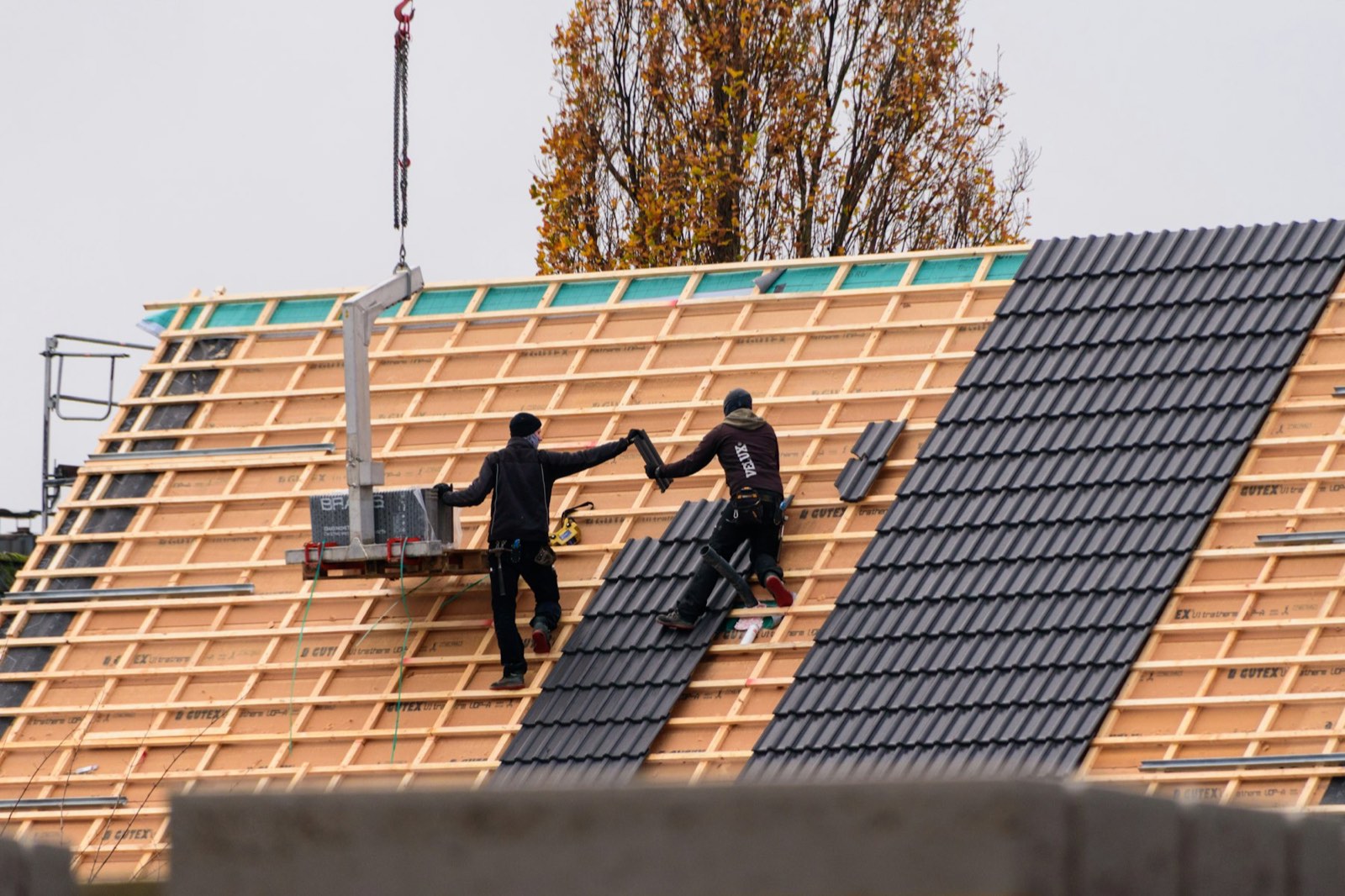
A full re-roof in England usually needs Building Regulations sign-off, and that normally means bringing the roof’s insulation up to current standards. Planning permission is usually not needed for like for like work. The exceptions are listed buildings, homes covered by an Article 4 Direction and changes that alter how the roof looks.
Building Regulations: when re-roofing needs approval
The Planning Portal says no building control application is normally needed for repairs or re-covering of a pitched or flat roof when both of these apply:
- less than 25% of the total building envelope (walls, floor, roof, windows and doors) is affected, and
- less than 50% of the roof is affected.
You do need approval if you go past those limits. You also need it for structural alterations, for a new covering with significantly different fire performance, or for a covering that increases the roof’s weight by 15% or more. The Planning Portal’s re-roofing page sums it up: “In most situations, this work will need Building Regulations approval.”
Two ways to get sign-off
- Use a registered roofer. gov.uk lists CompetentRoofer (run by the National Federation of Roofing Contractors) and NAPIT as competent person schemes for replacing roof coverings on pitched and flat roofs. A registered roofer self-certifies the work and you receive a compliance certificate.
- Apply to building control yourself, through the council or a registered building control approver, before the work starts.
Keep the certificate safe with your other house documents.
Approved Document L: the insulation upgrade
A roof is a “thermal element”. Re-covering it counts as renovation under Approved Document L, the official guidance on energy efficiency.
The 50% and 25% tests
Paragraph 11.3 says the whole roof should be improved to at least the U-value in Table 4.3 if either:
- more than 50% of the roof’s surface is renovated, or
- the work is a major renovation, meaning more than 25% of the surface area of the building’s external envelope is renovated.
The target in Table 4.3 is 0.16 W/m²K for a roof. For a cold loft, Approved Document L’s worked examples suggest about 250mm of mineral fibre or cellulose quilt between and across the ceiling joists. For rooms in the roof, insulation goes between and below or between and above the rafters.
When a lower standard is acceptable
Paragraph 4.13 allows the best standard that is technically and functionally feasible and pays back within 15 years, where 0.16 is not. Table 4.3 also allows a lesser standard where meeting it would limit headroom. An upgraded roof should generally be no worse than 0.7 W/m²K.
The 2026 edition
A new edition of Approved Document L has been published and takes effect on 24 March 2027 for most building work. Work before then follows the 2021 edition with 2023 amendments, which is what this guide quotes.
Changing the roof covering material
Swapping slate for concrete tiles, or tiles for something lighter, raises two separate questions.
Building Regulations. The Planning Portal says approval “is likely to be needed” for a change of covering, especially “where the replacement tile will be significantly heavier or lighter than the existing”, as “the roof structure may need modifying and/or strengthening”. It advises checking with a structural engineer or surveyor first.
Planning. Works that “do not materially affect the external appearance of the building” are not development under section 55 of the Town and Country Planning Act 1990. The Planning Portal says re-roofing that does not materially affect a house’s appearance “will usually not require planning permission”. A noticeably different material is less clear, so ask the council if you are not matching what is there.
Conservation areas and Article 4 in Shropshire
Shropshire has 128 conservation areas. In a conservation area, the council expects work to respect the area’s character, and an Article 4 Direction can remove permitted development rights altogether.
Shropshire Council lists “alterations to roofs and chimneys” and “changes to external materials and finishes” among the works commonly controlled by Article 4. Where a direction applies, you may need planning permission for work that would otherwise not need it. A householder planning application costs £548 from 1 April 2026.
Where the Article 4 areas are
The council’s Article 4 map data, checked on 17 October 2026, names these places:
- Shrewsbury: Belle Vue, the Town Centre areas (Cherry Orchard, Mountfields and St Julian’s Friars), Castlefields, Mountfields (extended), The Mount, Priory Ridge and a few individual addresses.
- Bridgnorth, including a separate Innage Gardens direction. This is the largest set of Article 4 features in Shropshire.
- Llanymynech, Prees and Highley Clee View.
We found no Article 4 areas for Ludlow or Oswestry, although normal conservation area controls still apply there. The map shows where a direction applies, not exactly which works each one covers, so check the council’s map and ask the council before you order materials.
In Telford & Wrekin, the Ironbridge Gorge World Heritage Site has its own Article 4 Direction, which includes roof alterations on houses fronting a highway, waterway or open space.
Clay tiles and Welsh slate
Shropshire’s historic towns have a strong roof character, and the council will expect it to be kept:
- Bridgnorth: the appraisal says “the dominant roof material of Bridgnorth is locally-manufactured clay tiles”, with some Welsh slate.
- Ludlow: “Old clay tiles and Welsh slate are the main roofing materials.”
Replacing these with concrete interlocking tiles is the kind of change that can need permission. It also changes the cost, which our roof replacement cost guide explains.
Listed buildings
If your home is listed, the rules are stricter. Under section 7 of the Planning (Listed Buildings and Conservation Areas) Act 1990, no one may alter a listed building “in any manner which would affect its character” without listed building consent. Doing so is a criminal offence under section 9.
Whether a roof job needs consent depends on its effect on the building’s character, so ask the council before anything beyond small like for like repairs. Listed building consent has no application fee.
Approved Document L also allows flexibility here. Paragraph 0.8 says work to listed buildings and homes in conservation areas need not fully meet the energy standards where that would “unacceptably alter” their character, and building control should consider the conservation officer’s advice.
There are a lot of listed homes in Shropshire’s towns. Historic England’s list has about 784 entries in Shrewsbury parish, about 425 in Ludlow and about 251 in Bridgnorth, and one entry can cover a whole terrace.
Bats
The law
All bats and their roosts are protected. Under regulation 43 of the Conservation of Habitats and Species Regulations 2017, it is an offence to deliberately disturb, capture, injure or kill a bat, or to damage or destroy a breeding site or resting place. The Bat Conservation Trust says roosts are protected “all year round, whether occupied or not”, and calls this “an absolute offence”.
gov.uk lists “repairing or replacing a roof” among the activities that can affect bats, and says offenders can face up to 6 months in prison or an unlimited fine.
When you need a survey or licence
Natural England’s guidance says a survey should be asked for if a development is likely to affect bats or their roosts. Features that suggest a roost include uneven roof tiles, large roof timbers, roofs that warm in the sun with a large roof space, and cracks, crevices and small openings.
If harm cannot be avoided, a mitigation licence from Natural England may be needed.
What to do
- Before work: call the National Bat Helpline on 0345 1300 228 (Monday to Friday, 9.30am to 4.30pm). It gives free advice on behalf of Natural England and can arrange a visit from a volunteer bat roost visitor.
- Plan the timing: the Bat Conservation Trust says people are commonly advised to work in April or between mid September and the end of October, when bats are least vulnerable.
- Choose the right felt: the Trust advises against non-bitumen coated (“breathable”) membranes in roofs used by bats, because bats can pull out fibres and become entangled. Bitumen felt type 1F is given as a suitable example.
- If you find a bat during work: pause all work, make sure the bat is not in danger, leave it in its roost and seek advice.
Before you start
Check three things before you sign a contract: whether your roofer can self-certify, whether your house is listed or in an Article 4 area, and whether bats might be present. Our guides to repairing or replacing a roof and flat roof options cover the other decisions.
Planning a new roof? Get a quote from a checked local roofer.
Common questions
Do I need Building Regulations approval to re-roof my house?
In most cases, yes. The Planning Portal says no application is normally needed only where less than 25% of the whole building envelope and less than 50% of the roof is affected. A roofer registered with a competent person scheme such as the NFRC's CompetentRoofer can self-certify the work instead of you applying to building control.
Do I need planning permission to change from slate to tiles?
Possibly. Works that do not materially affect the external appearance of a building are not development, so like for like re-roofing is normally fine. A visibly different material may need permission, and in a conservation area with an Article 4 Direction or on a listed building it very likely will. Check with the council first.
Is my house covered by an Article 4 Direction in Shropshire?
Shropshire Council publishes an online map to check. Its Article 4 data covers several areas of Shrewsbury, Bridgnorth and Bridgnorth Innage Gardens, Llanymynech, Prees and Highley Clee View. We found none for Ludlow or Oswestry in October 2026.
Do I need a bat survey before re-roofing?
Not always, but you must not harm bats or damage a roost. gov.uk lists repairing or replacing a roof as work that can affect bats. If you think bats use your roof, call the National Bat Helpline, which can arrange a free visit from a Natural England volunteer bat roost visitor. If a planning application is needed and bats are likely to be affected, the council can ask for a survey.
Is it illegal to do work to a listed building without consent?
Yes. Under the Planning (Listed Buildings and Conservation Areas) Act 1990, altering a listed building in a way that affects its special character without listed building consent is a criminal offence. Listed building consent has no application fee.
Related guides
Sources
- Planning Portal, Roof: Building Regulations, work to an existing roof
- Planning Portal, Roof: Building Regulations, re-roofing
- Planning Portal, Roof: planning permission
- Planning Portal, Roof: protected species
- MHCLG, Approved Document L Volume 1: Dwellings, 2021 edition incorporating 2023 amendments (paragraphs 0.8 to 0.13, 4.11 to 4.13, 11.2 to 11.4, Tables 4.3 and C1)
- gov.uk, Conservation of fuel and power: Approved Document L (2026 edition takes effect 24 March 2027)
- gov.uk, Competent person schemes: current schemes, updated 17 September 2026
- NFRC Competent Person Scheme
- legislation.gov.uk, Town and Country Planning Act 1990, section 55
- legislation.gov.uk, Planning (Listed Buildings and Conservation Areas) Act 1990, section 7
- legislation.gov.uk, Planning (Listed Buildings and Conservation Areas) Act 1990, section 9
- Shropshire Council, Conservation areas and Article 4 Directions
- Shropshire Council, Article 4 Direction GIS layer, queried 17 October 2026
- Shropshire Council, conservation area and Article 4 checker map
- Shropshire Council, Bridgnorth Conservation Area Appraisal, approved 26 April 1999
- Shropshire Council, Ludlow Conservation Area statement, May 1994
- Telford & Wrekin Council, Article 4 Direction (Ironbridge Gorge)
- Historic England, National Heritage List for England (listed building entries counted in ONS parish boundaries, October 2026)
- Ribble Valley Borough Council, Planning application fees from 1 April 2026 (national fee schedule)
- Natural England and DEFRA, Bats: protection, surveys and licences, gov.uk
- Natural England and DEFRA, Bats: advice for making planning decisions, updated 7 April 2025
- legislation.gov.uk, Conservation of Habitats and Species Regulations 2017, regulation 43
- Bat Conservation Trust, Know your responsibilities
- Bat Conservation Trust, Things to consider when planning works
- Bat Conservation Trust, Roofing membranes
- Bat Conservation Trust, I've found a bat during works