
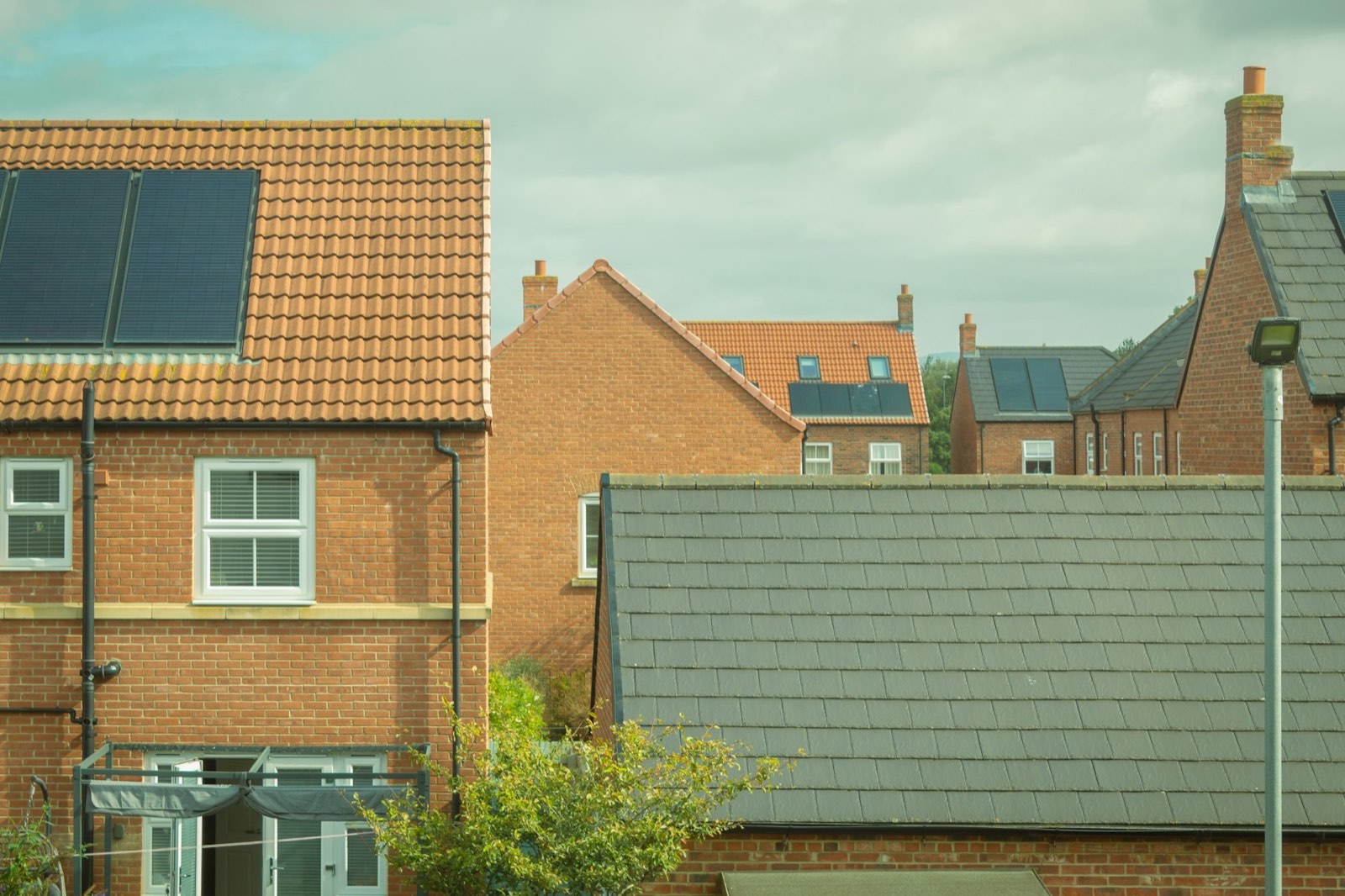
A household using Ofgem’s typical 2,500 kWh of electricity a year needs about 6 panels of 450 W on a south-facing Shropshire roof, or about 8 facing east or west, to generate as much as it uses over a year. Bigger users, and homes with a heat pump or electric car, need more.
Step 1: know your electricity use
Your annual use in kWh is on your bill or your supplier’s app. If you do not have it, Ofgem’s Typical Domestic Consumption Values give a guide. They were cut on 1 July 2026 to reflect falling household use:
| Usage level | Electricity a year (single-rate meter) | Before 1 July 2026 |
|---|---|---|
| Low | 1,600 kWh | 1,800 kWh |
| Medium (typical) | 2,500 kWh | 2,700 kWh |
| High | 3,800 kWh | 4,100 kWh |
Homes on a multi-rate meter such as Economy 7 use more: Ofgem’s medium value is 3,400 kWh. If you plan to add a heat pump or an electric car, your use will rise, so size for the future rather than last year’s bill. See our heat pump pages.
Step 2: how much each panel makes in Shropshire
We ran the European Commission’s PVGIS model for Shrewsbury, using its standard 14% system loss. Figures elsewhere in Shropshire will differ a little, so ask your installer for one run on your own address.
| Roof facing (35 degree pitch) | Yearly output per kW of panels |
|---|---|
| South | about 970 kWh |
| South-east or south-west | about 915 kWh |
| East or west | about 770 kWh |
| North | about 530 kWh |
| Flat roof, panels laid flat | about 810 kWh |
The best fixed angle PVGIS found for Shrewsbury was 40 degrees facing due south, giving about 974 kWh per kW, hardly more than a normal 35 degree roof. Most pitched roofs are close enough to ideal.
Panel wattage
Panel ratings vary. One large supplier fits 455 W panels, and a current 490 W panel measures 1,800 mm by 1,134 mm. We use 450 W below as a round figure: about 2.2 panels make 1 kW.
Step 3: put it together
To make as much electricity in a year as you use, divide your annual kWh by the yearly output per kW, then convert to panels. These are our calculations from the Ofgem and PVGIS figures:
| Household use | South roof | East or west roof |
|---|---|---|
| Low, 1,600 kWh | 1.7 kW, about 4 panels | 2.1 kW, about 5 panels |
| Medium, 2,500 kWh | 2.6 kW, about 6 panels | 3.2 kW, about 8 panels |
| High, 3,800 kWh | 3.9 kW, about 9 panels | 4.9 kW, about 11 panels |
Why many homes fit more than this
Matching your yearly use does not mean you stop buying electricity. PVGIS shows a south-facing kW in Shrewsbury makes about 121 kWh in May but only about 32 kWh in December. You will export in summer and import in winter.
That is why many homeowners fill the roof. Government cost data shows the median price per kW is lower for 4 to 10 kW systems (£1,546) than for systems up to 4 kW (£1,595), so extra panels are relatively cheap. The spare summer output can earn Smart Export Guarantee payments or charge a battery.
Roof space
A 490 W panel covers about 2 square metres and weighs 21.6 kg. As a rough guide:
- 6 panels need about 12 square metres of clear roof.
- 9 panels need about 18 square metres.
- 12 panels need about 24 square metres.
Add room for the gaps between panels and the clearance the installer leaves at the edges, ridge and around roof lights, vents and chimneys.
The weight matters too. The Planning Portal says the roof’s ability to carry the panels must be checked under building regulations, and some roofs need strengthening.
Orientation
South gives the most energy over the year.
East and west give about 80% of a south roof in Shrewsbury. With a slope each way, splitting the panels across both spreads generation over the morning and evening, which can suit a household that is out in the middle of the day.
North gives just over half the output of south. It is rarely the best use of money unless it is the only roof you have and you have a high daytime demand.
Flat roofs can take panels on frames. Laid flat they give about 810 kWh per kW in Shrewsbury; tilting them recovers more. Flat-roof panels have their own height limit under permitted development; see solar panels and planning permission.
Shading
Trees, chimneys, neighbouring buildings and dormers can all cut output, especially in winter when the sun is low.
Ask the installer to show how shading has been allowed for in their generation estimate. If a large part of the roof is shaded for much of the day, fewer panels in the clear area may be better value than a full roof.
Checking a quote
A good quote should state the system size in kW, the number and wattage of panels, the roof faces used, and an estimated yearly generation. Compare that estimate with the PVGIS figures above: a south-facing 4 kW system in Shropshire making far more than about 3,900 kWh a year deserves a question.
Then compare the price with our solar panel cost guide.
Ready to size your system? Get a quote from a checked local installer.
Common questions
How many solar panels does a 3 bed house need?
It depends on your electricity use, not the bedrooms. At Ofgem's typical 2,500 kWh a year, about 6 panels of 450 W facing south would generate the same amount over a year in Shropshire. Check your own annual kWh on your bill or energy app.
Are east and west facing roofs worth it?
Usually yes. PVGIS for Shrewsbury gives about 770 kWh per kW a year facing east or west, around 80% of a south roof. With panels on both slopes, output is spread across the morning and the afternoon.
Is a north facing roof any good for solar?
It is the weakest option. PVGIS gives about 530 kWh per kW a year for a north-facing 35 degree roof in Shrewsbury, just over half of a south-facing one.
How much roof space do solar panels need?
One current 490 W panel measures 1,800 mm by 1,134 mm, about 2 square metres, and weighs 21.6 kg. Nine panels need roughly 18 square metres of clear roof, plus room around the edges and obstructions.
Related guides
Sources
- Ofgem, Review of typical domestic consumption values: decision, 27 May 2026
- Ofgem, Energy price cap update from 1 July 2026 (revised TDCV letter)
- European Commission JRC, PVGIS 5.3 (SARAH3), Shrewsbury 52.707N 2.754W, 14% system loss, queried 17 October 2026
- Octopus Energy, Solar panels (455 W panels), checked 17 October 2026
- Solexis, LONGi Hi-MO X10 LR7-54HVH 490 W module specification
- DESNZ, Solar photovoltaic (PV) cost data, published 28 May 2026
- Planning Portal, Solar panels: building regulations